 Digital Scoop India Official Platform of Digital Scoop India Featuring Latest & Best News #Articles #Bytes #Entertainment #DigitalScoopMagazine
Related Articles
ART • INDIGENOUS HISTORY • ECOLOGY • TRIBAL LIFE
Through years of close observation of the Niyamgiri hills and Dongaria Kondh community, Odisha artist Satyabhama Majhi creates a painting that brings together nature, culture, spirituality and memory.
Bhubaneswar, Sept. 17:
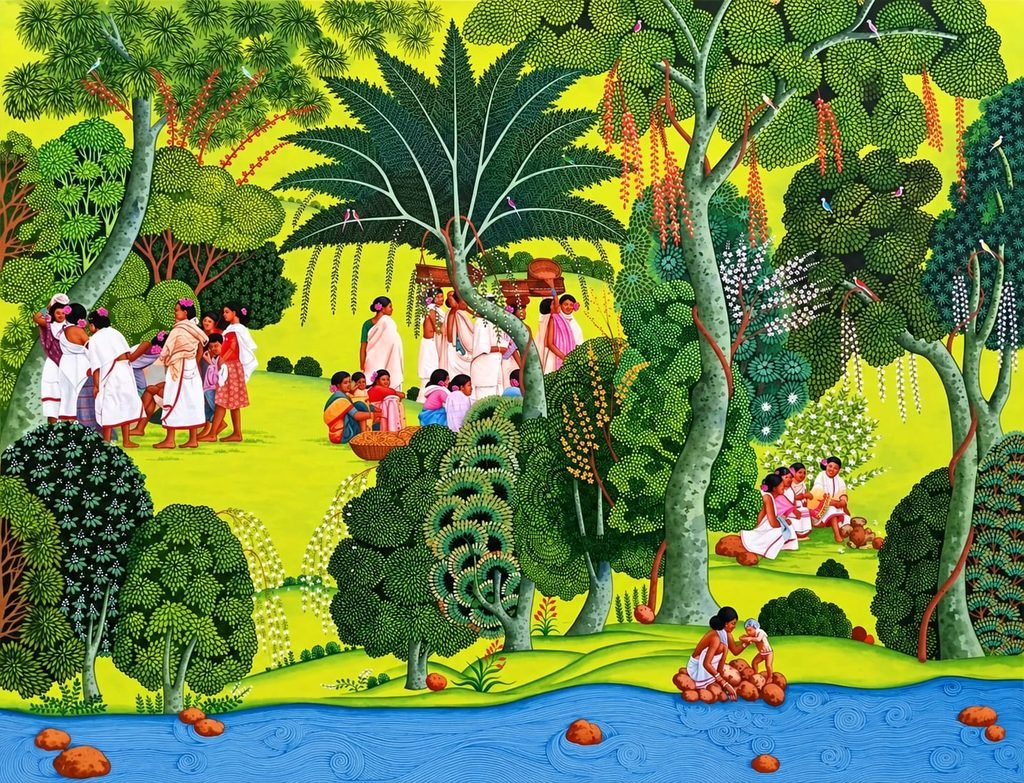
Some paintings are created simply to be viewed. Others invite the viewer into an entire world. Satyabhama Majhi’s distinctive Niyamgiri-inspired canvas belongs to the latter. Through detailed observations of the landscape and the everyday life of the Dongaria Kondh community, the Odisha-based contemporary artist presents a visual record of a way of life deeply connected with forests, land and spirituality.
For the Dongaria Kondh, a Particularly Vulnerable Tribal Group (PVTG) of Odisha, the Niyamgiri hills hold profound cultural and spiritual significance. The community’s relationship with the land is closely associated with Niyam Raja, and this connection forms an important part of Majhi’s artistic exploration.
An Artwork Shaped by Years of Observation
Majhi’s work is rooted in more than a decade of engagement with Niyamgiri and its communities. Rather than approaching the region only as an outside observer, her practice has focused on understanding everyday activities, traditions and relationships with the natural environment.
Her canvas brings together scenes of community life, including women carrying forest produce, gathering under trees, sharing conversations, playing music and caring for children near the river. These moments transform the painting from a conventional landscape into a broader visual documentation of life.
The artist describes the relationship between the community and Niyamgiri through the words:
“For the Dongria, Niyamgiri is not a mountain to see, but a deity to live within.”
The Forest as a Living Part of the Painting
Nature occupies a central position in the artwork. Trees, foliage, creepers, flowers, birds, rocks and water are carefully incorporated into the composition, creating an immersive representation of the Niyamgiri landscape.
The forest is not presented merely as a background. Instead, it becomes an active part of the story, reflecting the close relationship between the community and its surroundings.
Through this approach, Majhi connects ecology and cultural memory, showing how landscapes can carry stories about the people who live within them.
Five Earths Become a Medium
Natural materials are another important aspect of Majhi’s artistic practice. Her work draws from pigments associated with Niyamgiri, including chalk stone, charcoal, turmeric, geru soil and brown stone.
These materials connect the physical process of painting with the landscape being represented. Rather than treating soil and natural pigments simply as artistic resources, Majhi associates them with memory, identity and the spiritual relationship between the community and its environment.
As she describes her process:
“I ground five souls of Niyamgiri into colour and raised them into one sacred triangle where land becomes art and art becomes prayer to Niyam Raja.”
The idea reflects one of the central themes of her work: soil is not just colour; it can also become a carrier of memory.
Why the Painting Matters
Majhi’s Niyamgiri work can be viewed as a visual archive of community life, ecology and cultural traditions. As landscapes and lifestyles change over time, artworks documenting everyday practices can provide another way of remembering places and communities.
The painting brings together three interconnected layers:
- Ecological memory: trees, birds, water, rocks and other elements of the Niyamgiri environment.
- Cultural memory: everyday activities, community interaction, music, storytelling and traditional practices.
- Spiritual connection: the relationship between people, land and Niyam Raja.
This combination gives the artwork significance beyond its visual composition. It becomes a record of how land, culture and community can exist as interconnected parts of everyday life.
Satyabhama Majhi: Art, Memory and Community
Satyabhama Majhi holds an M.F.A. in Traditional Art and is the Secretary of the Sasatwa Foundation. Her wider practice includes the concept of Un-Urbanisation, through which she explores disappearing urban landscapes and community memories.
She was also a Co-Sutradhar of People’s Wall – Jan, Janani, Janmabhumi for the New Parliament House in New Delhi in 2023, a project commissioned by the Lalit Kala Akademi. She received the Odisha Lalit Kala Akademi State Award in 2012 and the National Lalit Kala Akademi Scholarship in 2009–10.
Her artistic journey has included exhibitions and projects at Bharat Bhavan, Bhopal, Nature Morte, Gurgaon, Lalit Kala Akademi, New Delhi, Bhubaneswar Art Trail, Gram Art Project and Vancouver Biennale-linked initiatives.
Her work also extends into art education and community engagement, including work with children in tribal schools, underserved communities and children with disabilities.
Land as Memory, Matter as Landscape
The Niyamgiri-focused work connects closely with Majhi’s broader artistic concerns and her participation in the group exhibition Land as Memory, Matter as Landscape at artCENTRIX Space, New Delhi.
The exhibition brings together ideas of changing cities, natural landscapes, indigenous knowledge and cultural memory. In Majhi’s work, the contrast between urban transformation and the enduring presence of Niyamgiri creates a larger conversation about what communities remember and what landscapes preserve.
Her artistic philosophy can be summed up through a simple idea: when land carries memory, art can become a way of keeping that memory visible.
Through her Niyamgiri canvas, Satyabhama Majhi brings together art, ecology, indigenous knowledge and cultural history, creating a work that documents not only a landscape, but the relationship between a community and the land it calls home.
Reference: Satyabhama Majhi’s official website